Specialist in Orthodontics · Dübendorf Orthodontics can do more than give you a beautiful smile
Kieferorthopädie am Hochbord in Dübendorf is the practice of Dr. med. dent. Amir Kanawati – Specialist in Orthodontics. We treat children, teenagers and adults – from early treatment through to discreet tooth correction. Every treatment begins with careful diagnostics and a plan made for you.
- Specialist in Orthodontics Treatment and planning by the same specialist – from the first consultation to the retainer.
- Early treatment from age three Open bites, crossbites, pronounced overjets and irregular growth can be spotted early and monitored.
- In-house laboratory with laser welding Orthodontic appliances can be fitted individually and adjusted here at the practice whenever they need to be.
- Digital diagnostics and 3D planning Digital radiography, digital models and 3D treatment simulation.
- No referral needed You can come to us directly.
- English · Deutsch We look forward to your visit! Wir freuen uns auf Ihren Besuch!
Member of

We work with

The practice
Your whole treatment in one pair of hands
Dr. Kanawati has worked exclusively in orthodontics since 2008. After more than eleven years running his own practice, he has also been practising as an orthodontist in the Zürich area since 2023. In 2026 he opened his own practice in Dübendorf, Kieferorthopädie am Hochbord.
What matters most to him is that patients are looked after personally – from the first consultation through the planning to the end of treatment.
- Specialist in Orthodontics (Fachzahnarzt für Kieferorthopädie)
- Member of the Swiss Dental Association SSO
- Member of the Zürich cantonal dental society SSO
- Consultation and treatment in English and German
- Practice at Ringstrasse 18a in the Hochbord quarter, Dübendorf
What we treat
What we offer
We treat with both fixed and removable appliances, choosing the system to suit the clinical findings, the patient's age and their everyday life. Which option is right for you is something we discuss once the diagnostics are done.
- Self-ligating mini brackets
- This system works without elastic ligatures, which makes daily cleaning easier. An integrated clip holds the archwire securely in place. We use it as standard in many treatments.
- Self-ligating ceramic brackets
- A discreet alternative to metal brackets. They also work without elastic ligatures and blend quietly into the natural appearance of the teeth.
- 3D stainless steel brackets
- These allow precise tooth movement. The archwire is held by elastic ligatures, which can make cleaning a little more work. We use them mainly for shorter treatments or in selected situations.
- Modern archwires
- Different wire materials are used depending on the stage of treatment. Alongside superelastic and thermoelastic wires we also use titanium-molybdenum alloy (TMA) where needed. This allows forces and tooth movements to be adjusted precisely.
- Early treatment from age three
- Early treatment is one of our areas of focus. Crossbites, a pronounced step between the upper and lower jaw and irregular growth can often be recognised and treated in childhood. Where the findings call for it, we begin from as young as three.
- Aligners
- Clear, custom-made trays that correct tooth position. They can be taken out for eating and for cleaning your teeth, and are a discreet alternative to fixed appliances.
- WIN lingual system
- These custom-made brackets are fitted to the inner surface of the teeth and are practically invisible in everyday life.
- Mini-implants
- An anchorage method that allows specific tooth movements independently of how consistently the patient wears an appliance – for example as a discreet alternative to headgear with a monobloc.
- Powerscope
- A development of the Herbst appliance, used to treat a lower jaw that sits too far back. Fixed in place, it works around the clock and does not depend on the patient remembering to wear it.
- Indirect bracket bonding
- The brackets are positioned in the laboratory on a custom 3D model and then transferred to the teeth using a transfer tray. This allows precise placement and an efficient course of treatment.
- Digital radiography
- We use digital radiography for diagnostics. The lateral cephalogram is taken with one-shot technology; the short exposure time allows precise images.
- Individual treatment planning
- Every treatment begins with careful diagnostics. On that basis we draw up a treatment plan matched to your personal circumstances and goals.
- Digital 3D treatment simulation
- For every treatment we produce a digital 3D simulation of the planned tooth movements, so the intended changes can be shown clearly before treatment begins.
- Smooth-surface sealing
- Before fixed braces are fitted we apply a protective varnish to the tooth surfaces. This helps protect the enamel during treatment.
- Deep fluoridation
- Fluoride strengthens the enamel and supports remineralisation. Regular fluoridation helps protect the teeth during orthodontic treatment.
- Professional tooth cleaning
- Regular professional cleaning helps remove plaque and discolouration and keeps the mouth healthy during treatment.
- Interim diagnostics and progress checks
- Regular progress checks help us monitor how treatment is going and adjust it where needed. For this we use current photographs, digital models and, where necessary, radiographs.
- Retainers
- Once treatment is complete, a retainer holds the teeth in their new position. For patients with sensitivities, alternative materials such as white gold are available on request.

Individual
Every treatment begins with careful diagnostics and a plan made for you.
Who we treat
Orthodontics at every age
Children
Many irregularities respond particularly well while a child is still growing. Where the findings call for it, treatment can make sense from as early as three years old. Not every irregularity needs treating straight away, though. After thorough diagnostics we explain whether treatment is necessary and when it would best begin.
Focus: early treatment of crossbites, pronounced overjets and irregular growth
Teenagers
The classic time for a comprehensive correction. We choose the system together – self-ligating mini and ceramic brackets.
We schedule appointments so they fit around school, sport and music lessons.
Adults
It is rarely too late to correct your teeth. Adults usually want an option that goes unnoticed at work and in daily life.
Aligners, ceramic brackets and the WIN lingual system, which sits on the inner surface of the teeth, are all options.

For children
Early treatment from age three.
How it works
From the first consultation to the retainer
-
First consultation
We look at the situation and discuss whether treatment makes sense, when it would best begin and which options are worth considering.
-
Diagnostics
Photographs, digital models and – where needed – radiographs give a complete picture. Everything else is built on that.
-
Treatment plan and cost estimate
You receive an individual treatment plan, on request with a written cost estimate, which you can go through at your leisure and submit to your insurer if you wish.
-
Treatment and monitoring
During treatment we check progress regularly and adjust where necessary. At the end, a retainer secures the result.

Continuity
One person to talk to, for the whole of your treatment.
Costs and insurance
Transparent about costs
Before treatment begins you receive, on request, a written cost estimate. You can submit this to your supplementary insurer if you wish.
Billing
We bill according to the SSO dental tariff (Dentotar). The tax point value is 1.15. For treatment charged to disability insurance (IV), the tax point value is 1.00.
Supplementary insurance
Orthodontic treatment is generally not part of the compulsory basic insurance. Whether a supplementary policy contributes, and how much, depends on your particular cover. We invoice you directly.
Disability insurance (IV)
For recognised congenital conditions, disability insurance (IV) covers treatment until the patient’s 20th birthday. This requires written approval from the responsible IV office before treatment begins. We help with the application.
Further information on cover by disability insurance is available from the Swiss Dental Association SSO: sso.ch/de/invalidenversicherung.

Together
Every person and every treatment is different – we will find the option that suits you.
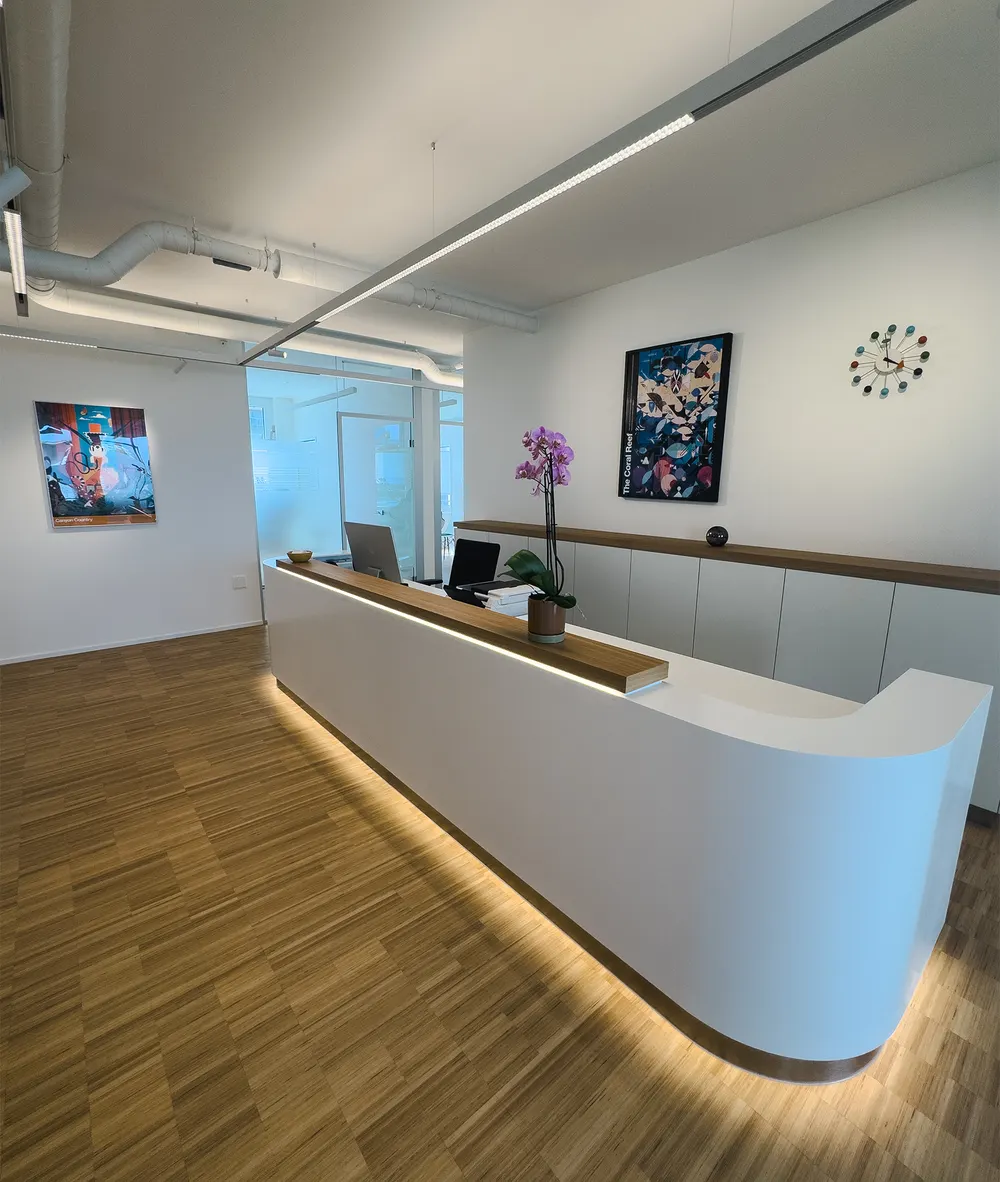
Inside the practice
A look around


Frequently asked questions
Good to know
A first orthodontic assessment usually makes sense around the age of six to eight, when the first permanent teeth come through. Where something stands out – a crossbite, a pronounced step between the upper and lower jaw, or a persistent habit such as thumb-sucking or tongue thrusting – it is worth looking earlier.
An examination does not automatically mean treatment. Often the point is simply to watch how things develop and to determine the right moment.
Early treatment is possible here from as young as three, where the findings call for it. Whether that is sensible in an individual case is something we work out together during the first consultation.
No, a referral is not required. You can come to us directly at any time. Many patients come on their dentist’s recommendation – but it is not a requirement. It is best to bring any existing records and radiographs with you, or we can request them for you.
We look at the position of the teeth and jaws and go through the questions that matter most: is treatment necessary? What happens if nothing is done? When would be the right time? Which systems are an option, and what will that involve?
We then note which records are needed for accurate planning.
That depends on the findings. Early treatment in childhood is usually considerably shorter than a comprehensive correction in the teenage years. You receive a reliable estimate after the diagnostics, together with the treatment plan.
Yes. Self-ligating ceramic brackets blend quietly into the natural appearance of the teeth. Aligners are clear and removable. With the WIN lingual system the custom-made brackets sit on the inner surface of the teeth and are practically invisible in everyday life.
Which option is clinically appropriate depends on the findings – we discuss that after the diagnostics.
Usually, yes. So that treatment continues seamlessly we need the existing records from the previous practice – treatment plan, models and radiographs. Talk to us and we will sort it out together.
Orthodontic treatment is generally not part of the compulsory basic insurance. If you hold supplementary cover, what it contributes depends on your policy. For recognised congenital conditions disability insurance (IV) covers treatment until the patient’s 20th birthday, subject to prior approval from the IV office.
On request you receive a written cost estimate from us before treatment begins. More on this under Costs and insurance.
It is an emergency when a problem with the appliance causes pain – a protruding archwire, for instance. A bracket that has come loose but does not hurt can wait for the next regular appointment.
If you are in pain you can reach us during opening hours on +41 43 234 8000. Please call before changing anything yourself – it is often possible to judge over the phone how urgently an appointment is needed.
Until your appointment, relief wax often helps: a small piece pressed over the spot that is rubbing protects the soft tissue. For sore spots, you can rinse with lukewarm salt water. Keep any loose parts and bring them with you. Please do not trim or bend anything yourself.
Outside our opening hours, contact the cantonal dental emergency service for Zürich: zahnnotfall-zuerich.ch, phone 0800 33 66 55.

Everyday life
Life with braces changes less than you might think.
Contact
We look forward to your visit
Kieferorthopädie am Hochbord
Dr. med. dent. Amir KanawatiSpecialist in Orthodontics
Ringstrasse 18a, 1st floor
8600 Dübendorf
- Phone +41 43 234 8000
- Email info@kfo-hochbord.ch
- Languages English, German
Opening hours
| Monday | 08:30 – 12:00 13:30 – 18:00 |
|---|---|
| Tuesday | 08:30 – 12:00 13:30 – 18:00 |
| Wednesday | 08:30 – 12:00 13:30 – 18:00 |
| Thursday | 08:30 – 12:00 13:30 – 18:00 |
| Friday | 09:00 – 12:30 |
| Saturday / Sunday | closed |
Appointments outside these hours by arrangement.
Getting here
The practice is at Ringstrasse 18a in the Hochbord quarter of Dübendorf, about a 10-minute walk from Stettbach station.
By public transport
Nearest stops: Dübendorf, Ringwiesen and Sonnental. From Stettbach station it is about a 10-minute walk to the practice.
By car
There are two paid parking spaces directly in front of the building; the first 30 minutes are free. The building also has an underground car park with 20 further visitor spaces.
